By Shreyashree S Rao and Lakshmi Sanjana P
Summary
Large Language Models can write and chat with human-like fluency. But sometimes, they confidently generate completely fabricated information—a flaw known as hallucination.
LLMs predict text based on patterns in data rather than verified understanding. Hallucinations arise due to problematic training data, probabilistic design of the models and vague user prompts. The stakes vary: harmless in creative writing, but dangerous in medicine, finance or public discourse where misinformation spreads fast.
Current solutions include better training data, detection tools and techniques that teach models to admit uncertainty. The real challenge is learning to trust AI where it's strong and verify it where it's weak. We're getting closer to a future where we can rely on it as a powerful partner - not blindly, but wisely.
Indroduction
Ever experienced this? You ask a chatbot a straightforward question, and it gives you a detailed, confident answer that turns out to be completely fabricated. It didn't just get it wrong - it invented the “facts” out of thin air. This isn't a simple glitch. It is one of the biggest hurdles that AI has to overcome, known as hallucination.
Large Language Models have entirely transformed how we interact with machines. They can write, summarize, and chat with a fluency that feels so human. But beneath the surface lies a fundamental flaw: sometimes, they generate answers that sound perfectly reasonable but are, in reality, nonsense, irrelevant, or just plain wrong.
Why does this happen?
At its core, these models are incredible pattern-matching engines. They learn from a vast amount of text and get very good at guessing which word should come next in a sentence. The catch? They do not understand if this is the truth. Since the powerful GPT-3 showed us just how fluent - and how frequently incorrect - an AI could be, hallucinations have become a central concern. While newer models are getting better, errors are enough to cause serious problems in critical fields.
The many faces of an AI hallucination
These fabrications aren't all the same. They pop up in different ways:
- Confident Lies: The model states something completely false with unwavering certainty. It might invent a historical event or a scientific discovery that never happened.
- Factual Slip-Ups: The model states simple facts incorrectly.
- Self-Contradiction: The AI argues two opposing points within the same response, not realizing it's tripping over its own logic.
- Nonsensical Text: The output is completely meaningless.
- Interpretative Issues: It basically misunderstands your question and answers a different one entirely.
- Faulty Memory (Retrieval-based): When trying to recall information the model was trained on, it retrieves the wrong details.
- Output expansion: The model adds unnecessary or invented information to an otherwise correct answer.
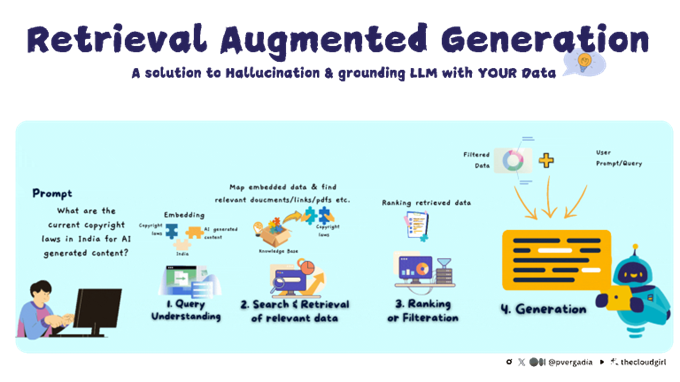 Figure 1 - Illustration of how the retrieval augmented method works. Source: https://www.thecloudgirl.dev/blog/rag-eliminating-hallucinations-in-llms
What's going wrong?
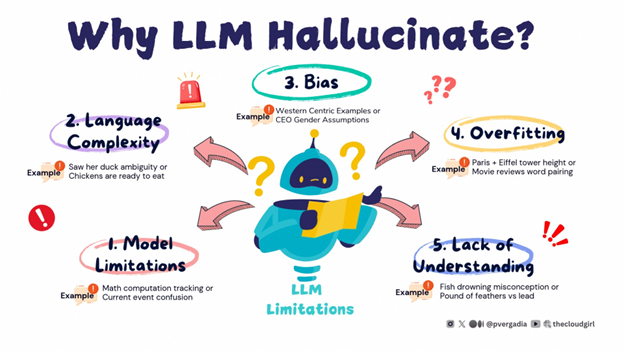 Figure 2 - Why do LLMs hallucinate? Source:
https://www.thecloudgirl.dev/blog/rag-eliminating-hallucinations-in-llms
Figure 2 - Why do LLMs hallucinate? Source:
https://www.thecloudgirl.dev/blog/rag-eliminating-hallucinations-in-llms
LLMs fabricate information mainly due to their fundamental design. The causes can be broken down into a few key areas:
1. The Foundation: Problematic Training Data
If an AI is trained on biased, inaccurate, or low-quality data from the internet, it will learn and reproduce those inaccuracies. Its output reflects a statistical average of its training data, not factual correctness.
Overfitting: Sometimes, an LLM learns its training material too well, making it rigid. When faced with new questions, it cannot adapt and instead invents answers based on learned patterns rather than admitting uncertainty.
2. The Core Mechanism: Probabilistic Nature
An LLM has no internal database of facts to check against. It is designed solely to calculate the probability of the next word in a sequence. Think of it as an advanced autocomplete. It's always choosing the most statistically probable continuation based on patterns in its training data, not based on an understanding of ground truth. LLMs lack a genuine mechanism to verify their output content. This is why it can generate text that is grammatically flawless and perfect, yet completely fictional.
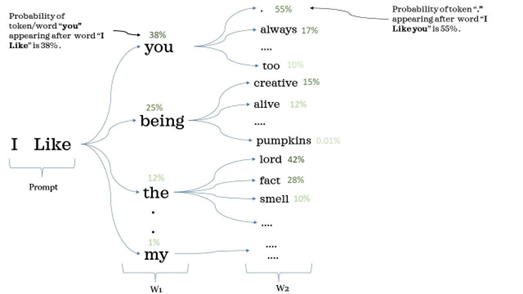 Figure 3 - An LLM selecting the most probable next word, demonstrating its probabilistic nature. Source: https://tinyurl.com/2udthem7
3. The User's Role: Vague prompts and Creative requirements
A vague, ambiguous, or complex prompt forces the LLM to make assumptions and fill in the blanks. Furthermore, techniques used to make its writing more creative (like asking it to "sound more human") can increase randomness, raising the chances of fabrication.
Why it matters: it's not just a tech problem
The impact of these hallucinations stretches far beyond a funny, incorrect answer to a trivia question. The consequences vary dramatically depending on the context.
In creative fields like creative writing, brainstorming or ideation, a little fabrication can be quite helpful. It can add a spark of creativity. Here, hallucinations might become fun and inspirational.
In medicine or finance: This is where hallucinations become dangerous. The cost of a confident-sounding mistake is unacceptably high.
- Medicine: A hallucinated medical diagnosis or treatment plan could lead to severe harm. Imagine an AI incorrectly summarizing a patient's file or providing a wrong diagnosis.
- Finance: Incorrect analysis of market trends or a misrepresentation of a company's financial data could lead to significant monetary losses.
In the public sphere: These errors can fuel misinformation, spreading false narratives online at an alarming scale. If we can't rely on AI to be accurate, we'll stop wanting to use it at all.
How do we detect and fix this?
Fixing the problem starts with detecting it. This is tougher than it sounds.
Detection: spotting the hallucination
- The Human Touch: For high-stakes areas, having domain experts fact-check the AI's output remains the most reliable method. However it is slow, expensive and cannot be scaled well.
- Automated Fact-Checkers: Researchers are developing tools that can automatically cross-reference AI answers against trusted sources.
- Reading its "Mind": Some fascinating new methods analyze the model's own internal reasoning process as it forms an answer. These methods look for the thought patterns that typically lead to a hallucination. One such technique, InterrogateLLM, has looked promising, spotting lies about 81% of the time without any external help.
Mitigation: building a more truthful LLM
We do not have a single solution, but a combination of strategies is making a difference:
- Better Data, Better AI: Curating higher-quality, more diverse and fact-checked training data is the most straightforward way to reduce nonsense from the start.
- Teaching "Honesty": Through advanced training techniques like Constitutional AI and Reinforcement Learning from Human Feedback (RLHF), we can teach models to be more cautious, to express uncertainty when they should and to prioritize factual accuracy.
- Smarter Text Generation: We can adjust the AI's architecture and settings. Techniques like lowering the "temperature" setting reduce randomness and Retrieval-Augmented Generation (RAG) are extremely good. RAG forces the model to ground its answers in real-time information fetched from external sources (like search engines or a company's database), keeping it factual and truthful.
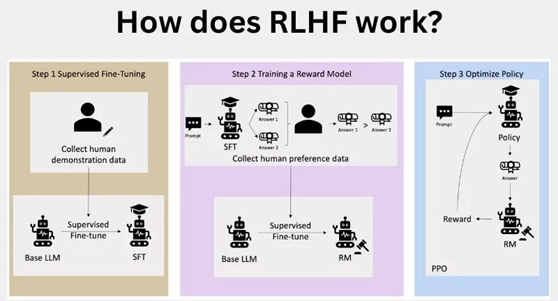 Figure 4 - How AI learns from human feedback: the three-step RLHF training process. Source: https://tinyurl.com/n4sdfw3y
What’s next?
The challenge of hallucinations in large language models remains an active and evolving area of research. The most promising approaches are becoming more data-centric and introspective. By creating specialized datasets to train models on fact-checking and even recognizing their own uncertainties, we can significantly reduce errors.
Alongside these improvements, the next generation of models are being designed with a richer understanding of context. This includes multimodal systems that combine text with images and other data types, using attention-guided decoding to cross-reference information. A key challenge for researchers is to refine these architectures. Models should maintain their creative potential without sacrificing factual accuracy. This ensures they are both imaginative and reliable.
Underpinning all these technical efforts is the crucial development of practical deployment strategies and clear ethical guidelines. As models become more sophisticated, establishing rules for their safe and responsible use in real-world systems is paramount. As we build more powerful AI, we must also build the necessary safeguards to manage its inherent fallibility.
Concluding remarks
We may never create an AI that is 100% accurate 100% of the time. The very nature of how it works makes some level of error probable. The goal isn't perfection, it's responsibility. We need to be transparent about the limitations, build robust safeguards and continuously work to improve them. Then, we can learn where it's strong and verify it when weak.
So, can we ever fully trust AI? Not blindly, no. But we're getting closer to a future where we can trust it as a powerful partner.
References:
- A Survey on Hallucination in Large Language Models: Principles, Taxonomy, Challenges, and Open Questions (2024)
- InterrogateLLM: Zero-Resource Hallucination Detection in LLM-Generated Answers (2024)
- The Law of Knowledge Overshadowing: Towards Understanding, Predicting, and Preventing LLM Hallucination (2025)
- A Comprehensive Survey of Hallucination Mitigation Techniques in Large Language Models (2024)
- Hallucination is Inevitable: An Innate Limitation of Large Language Models (2024)
- Constitutional AI: Harmlessness from AI Feedback (2022)
- What are AI hallucinations - IBM blog :
- Hallucinations in LLMs: types, causes and approaches for enhanced reliability (2024)